
When 14-year-old Suhas Gopinath started Globals Inc ten years ago from a cyber cafe in Bengaluru, he didn't know that he had become the youngest CEO in the world.
George Perkovich, vice president, studies, and director, Nuclear Policy Program, Carnegie Endowment for International Peace, believes that with the United States-India nuclear deal in limbo, the lack of convergence between Washington and New Delhi on Iran, climate change, the World Trade Organisation, and stagnation of defence cooperation, the US-India relationship has indeed been oversold.
Both Indians and Americans have to consider themselves fortunate and thankful to have a diplomat of the caliber of Indian Ambassador Nirupama Rao posted in Washington and driving the burgeoning United States-India strategic partnership, a senior State Department official has said.

The uncertainty over the fate of the Civil Nuclear Liability Bill in Parliament has caused a considerable amount of concern to members of the United States-India Business Council, as some of them had lobbied feverishly in the US Congress to get the agreement approved.USIBC President Ron Somers voiced his concerns at an interaction with Foreign Secretary Nirupama Rao, during her six-day visit to the United States
For more than a decade, Indian bureaucracy has continued to inhibit efforts by Indian American physicians to help the ailing health care there. This was the message conveyed by Dr Navin Shah, former president of the American Association of Physicians of Indian Origin, to Health Minister Ghulam Nabi Azad during an hour-long meeting on the sidelines of the United States-India Strategic Dialogue held in Washington, DC in June.
Some flights to Mumbai scheduled to depart from London's Heathrow airport on Sunday night were among half of scheduled 1,300 flights cancelled as authorities grappled with the fallout of snow and icy conditions across transport links in Britain.
A senior official in the Barack Obama administration has said that all contentious issues, including concern that Indian students are being duped by sham universities and colleges that have questionable credentials, would be on the table during the major United States-India Education Summit in October.

Leaders of the United States, India, Australia and Japan did discuss the 'challenge' posed by China during the first meeting of the Quad, and they made clear that none of them have any 'illusions' about Beijing, US National Security Advisor Jake Sullivan has said.
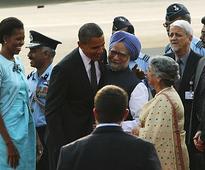
After the second US-India strategic dialogue, Aziz Haniffa finds growing concern about the civilian nuclear deal trapped in limbo.
Leading think tanks put a question mark on the India-US strategic partnership. Aziz Haniffa reports
The first United States-India Homeland Security dialogue began in New Delhi, during which Home minister P Chidambaram and his American counterpart Janet Napolitano deliberated on issues such as mutual assistance in probes such as the Mumbai terror attacks and counter-terrorism.
After her meeting with External Affairs Minister S M Krishna, US Secretary of State said that Indo-US strategic partnership can be upped beyond 3.0 level that she had envisaged. Aziz Haniffa reports
The fundamental challenge to United States-India strategic cooperation is China, says Daniel Markey, senior fellow for India, Pakistan, and South Asia at the Council on Foreign Relations, where he specialises in security and governance issues in the subcontinent.
The recent attack on the Delhi high court exposes lacunae in India;s counterterrorism efforts, says Dr Sahibzada Amer Latif, a visiting fellow at the Center for Strategic and International Studies in the newly established Wadhwani Chair for United States-India policy studies.
Ron Somers, president of United States-India Business Council, has termed the Indian government's rollback of foreign direct investment in the multibrand retail sector as yet another addition to the disappointments American business and industry has had to endure.
With billions of dollars in military technology agreements likely to be made with the United States-India nuclear deal going through, there's an excited buzz among American companies.
Corporate America does not believe that the United States-India relationship has been oversold, but that it's certainly over-hyped. However, it is more concerned over New Delhi's recent actions such as retroactive taxes and predicts all of this will lead to foreign direct investment drying up at a time when India needs it more than ever.
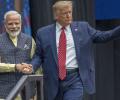
Pence, in response to a question from Chambers, who is also the USISPF chairman, said that he truly believes that the relationship between the US and India, because much of the work that the corporate sector have done, and the work of President Donald Trump and Prime Minister Narendra Modi, has never been stronger.
Students planning to attend university in the United States are invited to attend a pre-departure orientation programme on July 2.
'You have to explain to them about Indian investments in the US creating jobs this reverse outsourcing'

'The Indian activities at the UN are fully reflecting the merit of our special and privileged strategic partnership'
The Obama administration has declared that the Indian American community has always been and will continue to be indispensable to the United States-India Strategic Dialogue. Assistant Secretary of State Robert Blake, who will be by Secretary Hillary Clinton's side as she co-chairs the talks with External Affairs Minister S M Krishna, explained how integral the Indian American community has been to this dialogue.
In an exclusive interview, Strobe Talbott, a key protagonist in resurrecting the United States-India relationship after India's nuclear tests in May 1998, talks about the US-India relations, Iran and the Pakistan situation to Rediff.com's Aziz Haniffa.

US Commerce Secretary has appointed Purnima Voria to a new National Advisory Council
Paving the way for India and the United States to work together in enhancing global energy security, the Senate on Tuesday unanimously cleared a Bill seeking the diversification of sources of energy and stimulating development of alternative fuels.
PricewaterhouseCoopers surveyed 1,201 chief executives in 69 countries.
Rahul Bedi, the New Delhi-based correspondent of Jane's Defence Weekly, tells Sheela Bhatt why the rapid American shift of the Indian military hardware is a dangerous development.
The Hyde Act, signed into law by President Bush in December last year, grants the President authority to waive certain sections of the Atomic Energy Act of 1954 and the 1978 Nuclear Nonproliferation Act
India's present growth is not a sign of economic prowess; it is a choice most countries do not make because the concurrent high inflation typically targets the poor, says Derek Scissors.
India's present growth is not a sign of economic prowess; it is a choice most countries do not make because the concurrent high inflation typically targets the poor, believes Derek Scissors.
In yet another step towards full implementation of the United States-India civilian nuclear deal -- which the Obama administration has been accused in some quarters of not being fully committed to -- US President Barack Obama on Wednesday issued a memorandum certifying the agreement between India and the International Atomic Energy Agency of the Safeguards Agreement on India's civilian nuclear facilities.
While receiving Indian Prime Minister Manmohan Singh at the White House last November, President Barack Obama had termed the United States-India ties as one of the 'defining relationships' of this century.
The lawmakers lacked imagination, he said.

"Pakistan must be dissuaded from using terrorism as a state policy, and part of the US engagement with Pakistan should be focused on that result," says Ed Royce, senior Republican lawmaker.
The United States-India Educational Foundation (USIEF) invites Indian citizens to apply for the 2009 Fulbright-Nehru Environmental Leadership Programme (FNELP) Fellowships.
Ron Somers, president, United States-India Business Council speaks his mind about Indo-US tiff over outsourcing.
India, together with Japan, Brazil and Germany, nicknamed the Group of Four -- is lobbying for a permanent Security Council seat, and the quartet has circulated a revised draft proposal that would expand the body from 15 to 25 members.
An obviously chagrined United States-India Business Council, which has lobbied feverishly for the passage of the US-India civilian nuclear deal in the US Congress, on Monday issued a guarded reaction to the passage of the nuclear liability bill in the Parliament that had 'compromised on the indemnity clause demanded by American companies to protect it from liability in case of a nuclear accident.'
United States-India Educational Foundation (USIEF) invites applications for Fulbright-Nehru and other fellowships from Indian citizens residing in India.
Staff from the United States India Educational Foundation hosted a chat with rediff.com readers on June 23. The transcript.
